



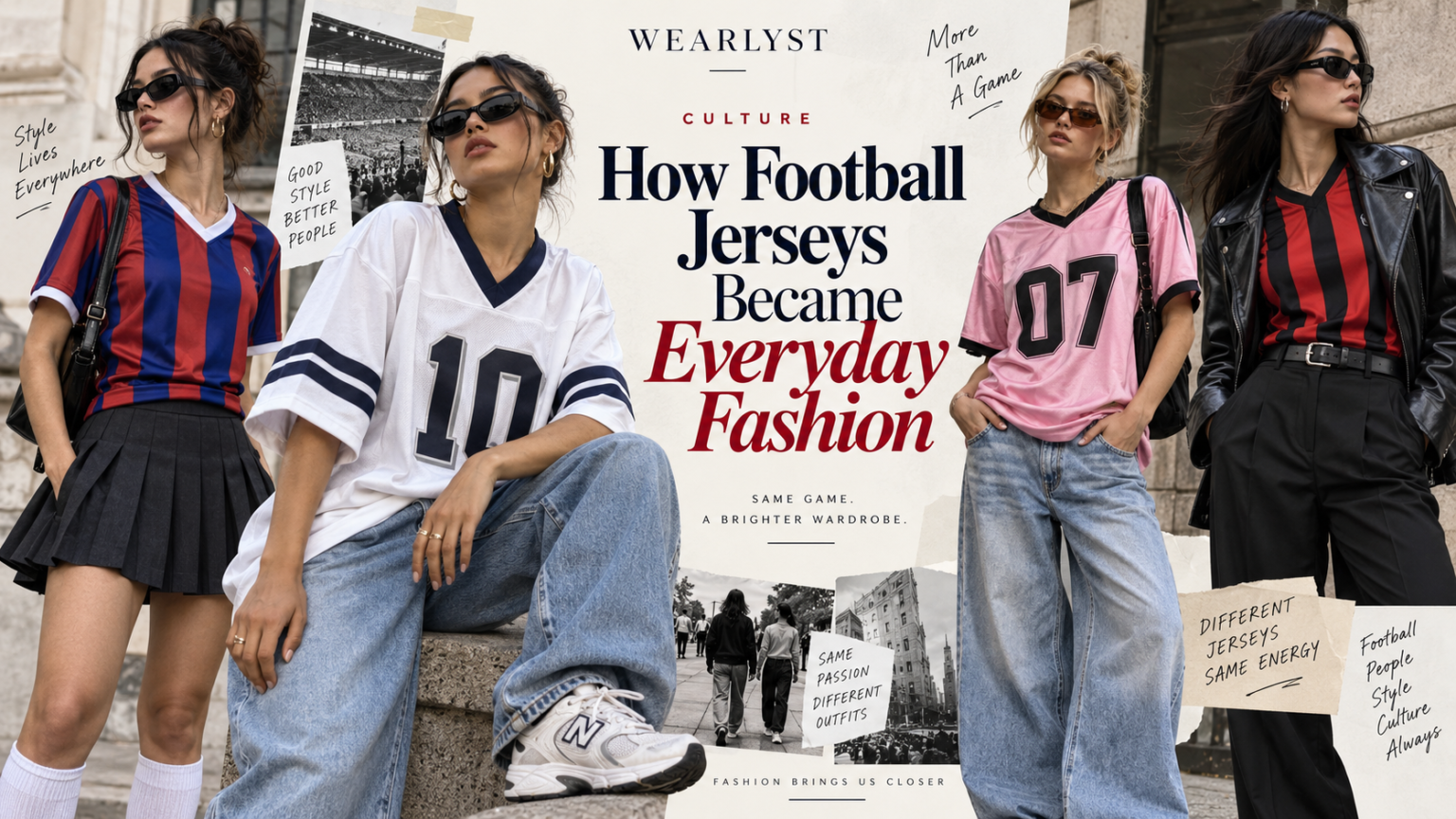
Football shirts once belonged almost entirely to stadiums, training grounds, and match-day crowds. Today, they appear in street-style photos, cafés, college campuses, music videos, fashion editorials, and everyday outfits. The shift is not really about football alone. It is about identity, nostalgia, music, streetwear, and the way internet culture constantly changes how we dress.
Editorial Note: This article explores football jerseys as part of contemporary fashion and culture. Club names and trademarks belong to their respective owners.
In This Story
- From Stadium Uniform to Cultural Symbol
- Why Fashion Started Paying Attention
- The Rise of Blokecore
- Music, Celebrities, and Street Culture
- Why Club Jerseys Work So Well in Fashion
- The New Rule: Style It Like a Graphic Tee
- Football Fashion Is Really About Identity
- Why Vintage Football Shirts Feel Different
- How Women Expanded Football Jersey Styling
- Football Jersey Fashion FAQs
When a Jersey Stops Being Just Sportswear
A Real Madrid shirt with denim shorts. A Barcelona jersey with a pleated skirt. An Inter Miami shirt worn with baggy jeans. An AC Milan jersey layered into a dark streetwear outfit.
These combinations would have looked unusual in mainstream fashion not that long ago. Today, they feel completely natural.
The football jersey has moved beyond the role it was originally designed for. It is still a symbol of a club and its supporters, but it can also function like a graphic tee, a vintage collectible, a streetwear piece, or simply the strongest visual element in an outfit.
Wearlyst Culture Note: Fashion rarely keeps clothing inside its original category. Sportswear becomes streetwear. Workwear becomes everyday clothing. Uniforms become style references. Football jerseys are another example of that cycle.
From Stadium Uniform to Cultural Symbol
A football jersey communicates something before the person wearing it says a word.
It can represent a club, a city, a player, a family tradition, a championship, a childhood memory, or a particular era of football.
That emotional connection is one of the things that separates jerseys from ordinary graphic T-shirts.
A vintage football shirt can immediately remind someone of a legendary player, an unforgettable match, or a period when a particular club dominated the sport.
The design itself also carries history. Sponsors change. Collars change. Materials evolve. Kits move between minimal designs and highly graphic patterns.
Colors may remain familiar, while the details around them constantly change.
For football supporters, those details can instantly identify a particular season.
For fashion enthusiasts, those same details create visual character.
The Difference: A football jersey is not only a piece of clothing. It often arrives with a story already attached to it.
Why Fashion Started Paying Attention
Fashion has always borrowed from sport.
Basketball sneakers became everyday footwear. Baseball caps became universal accessories. Track jackets moved from athletic clothing into streetwear. Rugby shirts became part of preppy wardrobes.
Football jerseys fit naturally into the same evolution.
Their proportions work especially well with the relaxed silhouettes that dominate modern casual style.
Oversized jerseys can sit over mini skirts, denim shorts, leggings, or slim trousers.
Regular-fit football shirts also work easily with baggy denim, wide-leg trousers, cargo pants, and casual sneakers.
They also have something modern fashion constantly searches for: strong color, recognizable graphics, and built-in personality.
You often do not need much else to make the outfit interesting.
The jersey already does most of the visual work.
The Rise of Blokecore
The internet helped give football-inspired everyday dressing a popular name: blokecore.
At its simplest, the formula looks something like this:
Football Jersey + Relaxed Denim + Sneakers
Part of the appeal comes from nostalgia.
The look references football supporter culture, vintage sportswear, casual pub style, retro kits, and the relaxed clothing traditionally associated with football fans.
Social media quickly pushed the idea beyond that original reference point.
Women began styling oversized jerseys with pleated mini skirts, shoulder bags, sunglasses, loafers, and feminine accessories.
Others mixed football shirts with tailored trousers, leather jackets, trench coats, or structured handbags.
Once that happened, the football jersey became much more interesting from a fashion perspective.
It was no longer only about copying traditional supporter style.
It became about contrast.
- Sporty with feminine.
- Vintage with modern.
- Casual with tailored.
- Football culture mixed with personal style.
That contrast is one of the main reasons football jersey fashion continues to feel fresh.
Music, Celebrities, and Street Culture
Football and music have always occupied similar cultural spaces.
Artists wear club shirts onstage. Musicians reference football clubs and players. Fans copy what performers wear. Fashion communities then reinterpret those looks online.
That cycle moves much faster today because of social media.
Someone posts an oversized football jersey with loose denim and retro sneakers.
Another person adds a mini skirt.
Someone else throws a blazer over the shirt.
A stylist adds jewelry, sunglasses, and a structured bag.
Within a short period of time, the same piece of clothing can move through football culture, music culture, TikTok, Pinterest, street style, and mainstream fashion.
The internet does not really care what category an item originally belonged to.
If people find an interesting way to wear it, the meaning of the item can change.
Why Club Jerseys Work So Well in Fashion
Different football clubs naturally create different visual identities, which makes their shirts surprisingly versatile as fashion pieces.
Real Madrid

The traditional white shirt feels clean and minimal.
It works naturally with light-wash denim, beige trousers, gray, black, and neutral sneakers.
Barcelona

Barcelona’s blue-and-red palette is much more graphic.
The shirt already brings strong visual energy, so it often works best when the rest of the outfit stays relatively simple.
Inter Miami

The club’s pink identity gives its jersey a softer and more fashion-forward appearance compared with many traditional football shirts.
Pink pairs especially well with relaxed denim, white sneakers, black accessories, and modern streetwear silhouettes.
AC Milan

Red and black naturally fit darker wardrobes.
The shirt works particularly well with black trousers, leather jackets, dark denim, and retro sneakers.
Manchester United

The classic red jersey is immediately recognizable and easy to combine with denim, black trousers, white sneakers, or darker outerwear.
Paris Saint-Germain
PSG shirts often feel naturally compatible with streetwear because the club sits at the intersection of football, Paris, youth culture, and modern lifestyle branding.
Why It Works: The club shirt supplies the color and identity. The rest of the outfit only needs to support it.
The New Rule: Style It Like a Graphic Tee
The easiest way to wear a football jersey outside match day is to stop treating it like sports equipment.
Treat it like a graphic T-shirt.
If the jersey is oversized, balance it with a skirt, shorts, fitted trousers, or structured accessories.
If the shirt already has strong colors, keep the rest of the palette simple.
If you want a more feminine look, pair it with a mini skirt, shoulder bag, jewelry, or clean sneakers.
If you prefer streetwear, combine it with baggy denim, cargo pants, retro sneakers, and sunglasses.
For something more elevated, try relaxed tailored trousers, loafers, or a leather bag.
Simple Formula: Let the jersey be the statement piece. Everything else should make it easier to wear.
Football Fashion Is Really About Identity
One reason football jerseys may last beyond a short-lived fashion trend is that they carry identity.
Fashion has always been one of the easiest ways for people to communicate something about themselves.
Music fans wear band T-shirts.
Students wear university sweatshirts.
People wear clothing connected to cities, communities, artists, movements, teams, and personal memories.
Football jerseys work in a similar way.
For one person, a shirt may represent lifelong loyalty to a club.
For someone else, it may remind them of a favorite player or a memorable tournament.
Another person might simply love the design, the colors, or the vintage aesthetic.
The meaning does not have to be identical for everyone.
That flexibility is part of what makes the jersey culturally powerful.
Does Wearing a Jersey for Fashion Make You Less of a Fan?
This question often appears whenever sports clothing enters mainstream fashion.
Some supporters see football shirts as something closely tied to club identity and believe the meaning behind the shirt matters.
Others enjoy seeing football culture spread beyond traditional fan communities.
Both perspectives help explain why football jerseys remain culturally interesting.
Fashion constantly borrows symbols from subcultures, sports, music, and communities.
At the same time, it is worth remembering that a jersey may carry much more meaning for someone else than simply being a visually interesting piece of clothing.
You can appreciate the fashion while still understanding that the shirt may have history behind it.
Why Vintage Football Shirts Feel Different
Vintage jerseys have become especially desirable because older football shirts often look very different from modern kits.
The collars can be larger. Sponsors can feel more graphic. Colors can be slightly faded. Materials and cuts reflect the era in which the shirt was produced.
Those characteristics often make an older shirt easier to style as fashion because it can feel less like current athletic merchandise and more like a piece discovered from another period.
That is why a vintage football shirt can work naturally in the same wardrobe as old denim, leather jackets, retro sneakers, and thrifted accessories.
Everything shares the same sense of history.
How Women Expanded Football Jersey Styling
One of the most interesting parts of modern football fashion is the way women have expanded the styling possibilities of the jersey.
The traditional supporter outfit was often straightforward: a club shirt, jeans, and sneakers.
Modern styling introduces much more contrast.
- Oversized jersey + pleated skirt
- Football shirt + ballet flats
- Pink jersey + baggy denim + shoulder bag
- Red jersey + leather jacket
- Vintage football shirt + tailored trousers
These combinations push football shirts beyond the visual language of the stadium and into the broader world of everyday fashion.
They also prove that a jersey does not need to define the entire outfit.
It can simply become one strong element inside a much more personal look.
Why Football Jersey Fashion Works So Well on Social Media
Football shirts are naturally recognizable in a social feed.
They have bold colors, strong graphics, large numbers, club badges, and distinctive patterns.
That makes them visually effective in short-form content where an outfit needs to communicate quickly.
A jersey can become the focal point of a photo or video almost immediately.
It also gives creators an easy styling formula to build around.
One shirt can be styled with jeans in one post, a skirt in another, and tailored trousers in the next.
That versatility makes football fashion especially suitable for Instagram, TikTok, and Pinterest outfit content.
Football Jerseys Are Becoming Wardrobe Pieces
Perhaps the biggest change is that many people no longer treat jerseys as clothing that only comes out on match day.
They are becoming part of the everyday wardrobe.
A football shirt can now sit next to hoodies, graphic tees, denim jackets, knitwear, and button-down shirts.
That does not mean the jersey has lost its connection to sport.
It means its cultural role has expanded.
The same item can now represent fandom, nostalgia, streetwear, fashion, and personal identity at the same time.
Football Jersey Fashion FAQs
What is football jersey fashion?
Football jersey fashion refers to styling soccer shirts as everyday clothing instead of wearing them only for matches.
Jerseys are commonly paired with denim, trousers, skirts, sneakers, jackets, handbags, and other everyday accessories.
What is blokecore fashion?
Blokecore is an internet-driven fashion aesthetic influenced by traditional football supporter style.
Football shirts, relaxed denim, casual sneakers, retro sportswear, and vintage-inspired pieces are common elements of the look.
Can you wear football jerseys casually?
Yes. One of the easiest approaches is to treat the jersey like a graphic T-shirt.
Pair it with everyday pieces such as jeans, shorts, trousers, skirts, sneakers, and simple accessories.
Why are vintage football shirts popular?
Vintage football shirts combine nostalgia, distinctive design, club history, and scarcity.
Their older cuts, sponsors, colors, collars, and graphics can also make them visually different from modern kits.
Are football jerseys part of streetwear?
Football jerseys increasingly overlap with streetwear because they work naturally with relaxed denim, sneakers, cargo pants, jackets, and oversized silhouettes.
Their strong visual identity also makes them effective statement pieces.
How do you style a football jersey without looking like you are going to a match?
Keep the rest of the outfit grounded in everyday fashion.
Try straight-leg jeans, tailored trousers, a mini skirt, a leather jacket, loafers, retro sneakers, or a structured bag.
The goal is to make the jersey one part of the outfit rather than recreating a full football kit.
The Takeaway
Football jerseys becoming everyday fashion is not as strange as it might first seem.
Sports, music, streetwear, celebrity style, nostalgia, and internet culture are constantly borrowing from one another.
The modern football shirt sits right in the middle of all of them.
What was once something people primarily wore for ninety minutes on match day can now become the starting point for an entire outfit.
That is what makes football fashion interesting.
It is not only about which club appears on the shirt.
It is about the history behind it, the culture around it, and what the person wearing it chooses to do with it.
Wearlyst Culture: Fashion becomes most interesting when clothing carries a story beyond the outfit itself.